I started July by taking a bit of time off - No big plans, just some time with family. Then the children did a few weeks of summer camp while I worked. Then I ended August with two (exhausting) weeks of amusement parks, road trips and visits with people I don't see often enough.
Workwise, this summer was mostly a lot of service mapping, zooming out and slowly working our way through complexity to something tangible.
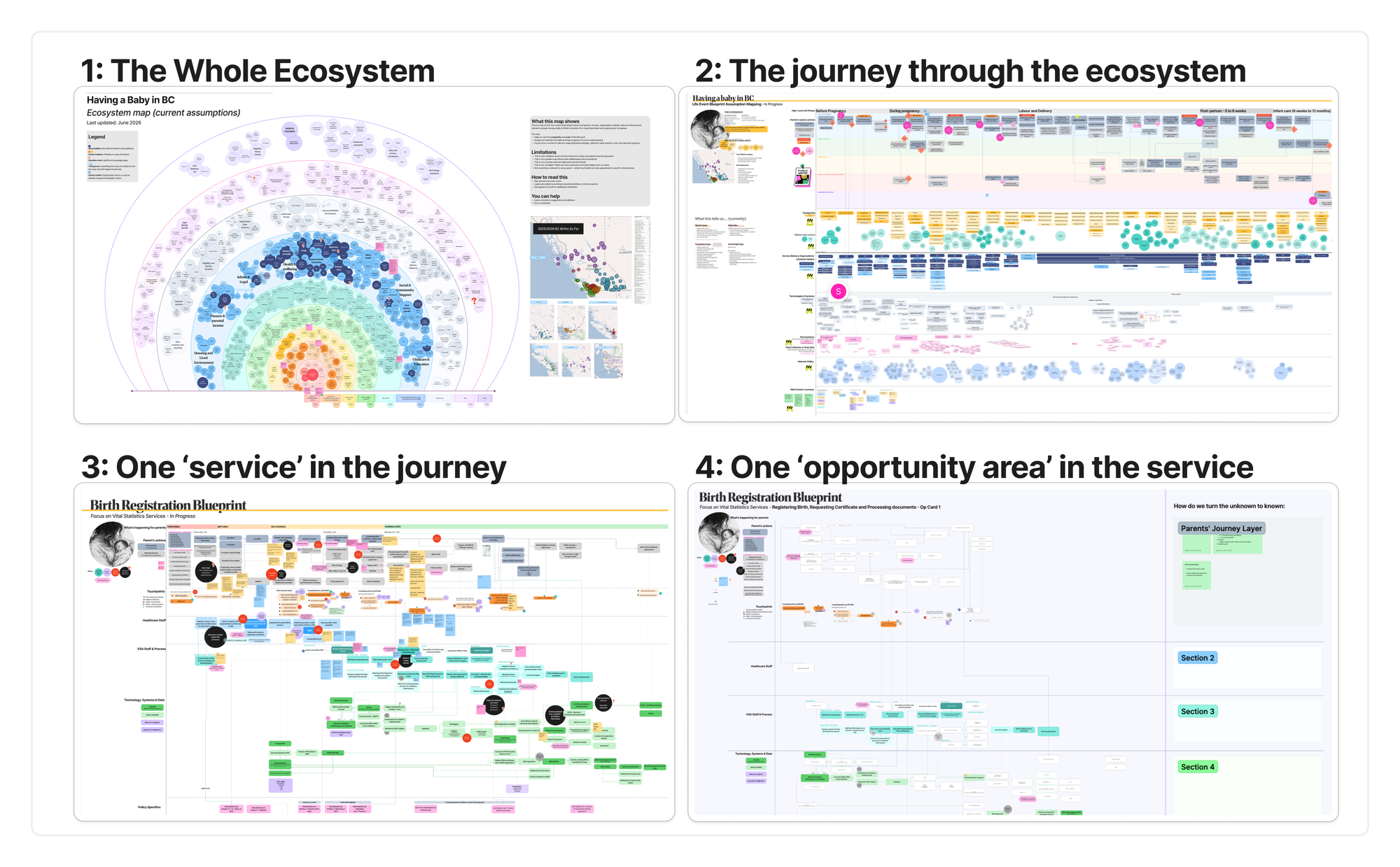
Our 'having a baby' design team created an ecosystem map depicting all of the government organizations, touchpoints, channels, content pieces, systems and policies that someone having a baby could come across. The scope was very wide (ranging all the way from planning for pregnancy to sending a child to post-secondary) and so that map was fairly chaotic and overwhelming. Which I think was the point, to show how much out is out there (it's a lot.)
To help us understand that ecosystem across the sequential journey, we then turned the eco-system map into a blueprint. It helped us see which stages of the life event have the most complexity and which might be gaps.
Then we were directed to zoom into a specific part of the journey and we started working with a partner org to understand the layers better. Up until this point, all of our mapping had been based on educated guesses, so we really welcomed the opportunity to start building tangible knowledge. However, 90% of our blueprint is still unvalidated.
Now we're zooming quite closely into a few 'opportunity areas' to strengthen our understanding and, I suppose, formulate some hypotheses.
Anyway, here's what that looked like (credit to my co-designers Srushti, Elizabeth and Ka Bo, as well we as the rest of our fantastic team, also credit to another life events team who's ecosystem template we duplicated, thank you Michaela!)
Zooming out, then zooming in: Our process of mapping the journey of having a baby in BC
There were lots of meetings: team sprint rituals (we do standups twice a week, plus retros, planning, and reviews) plus our design team ends up meeting almost daily to divide up work and make ongoing decisions about our direction. We also had some longer alignment sessions (for our project team and for our work unit,) cross-org design connections, quite a few demos and sprint reviews from related teams.
Reflection: There's a tendency where I work to see meetings as a distraction but as long as they are well-organized and purposeful, I'm mostly pro-meeting, especially in our current state of uncertainty and disconnection. Meetings are how we learn, share, build trust and get comfortable with each other, which builds our momentum as a team. I'm reminded of this 2023blog post which still feels relevant.
I took on some small leadership responsibilities.
I worked in an office with other people for the first time in many months (it was lovely, already planning on doing that more.)
What was good
I sort of love building maps, especially when building it around people's lived experiences. Time passes quickly when I'm stuck into a blueprint, so when I was able to carve out longer focus periods things felt very productive.
The work I'm doing feels genuinely interesting, and the people on our team are lovely. After a couple of years working in a Ministry where my work was often loosely organized (or poorly self-organized) around ad-hoc projects, it's been refreshing to be working in an agile-ish way again - I find the predictability, repetitive rituals and deadlines help me deliver better, more impactful work.
What was hard
We've not yet done any user research, and there's only a little validation on the maps we are creating, so I worry that our maps make it look like we've done our homework when we've really only pieced together various things copied from other people's pages. We're always quick to point out that this is all educated guesses, but regardless decisions are already being made (by who or what I'm not totally sure) on which opportunities to zoom in to. From a human-centred design lens, this doesn't feel ideal, although I do agree that it makes sense to narrow our efforts to things in our control and not waste people's time on problems we can't fix. And yet....I long for a vision that goes beyond what's technically easy and stays open to what matters to people. We can do both. I find myself missing the old days of boldness and transformation and users first.
Team alignment challenges. Our team was pulled together rapidly, and we didn't have enough time or space in the beginning to sort out some of the basics: who does what role, who is responsible for what, are all the roles covered, definitions of both work and success. We've been working through questions like, what is considered a 'partner engagement' vs 'internal research'? What falls under service design vs business analysis?
What else?
I read a few books; one notable read was The Immortal King Rao by Vauhini Vara. It's a dystopian story about an idealistic tech founder whose tech company ends up taking over global governance. It felt a bit work adjacent, as it looks the (catastrophic) impact on society and the environment when private industry controls public services (and everything else.) I wasn't sure I would enjoy this but it was well worth reading (even though it kind of gives me nightmares now)
My children go back to school next week, my eldest to her new middle school. Lots of nerves (including mine.)
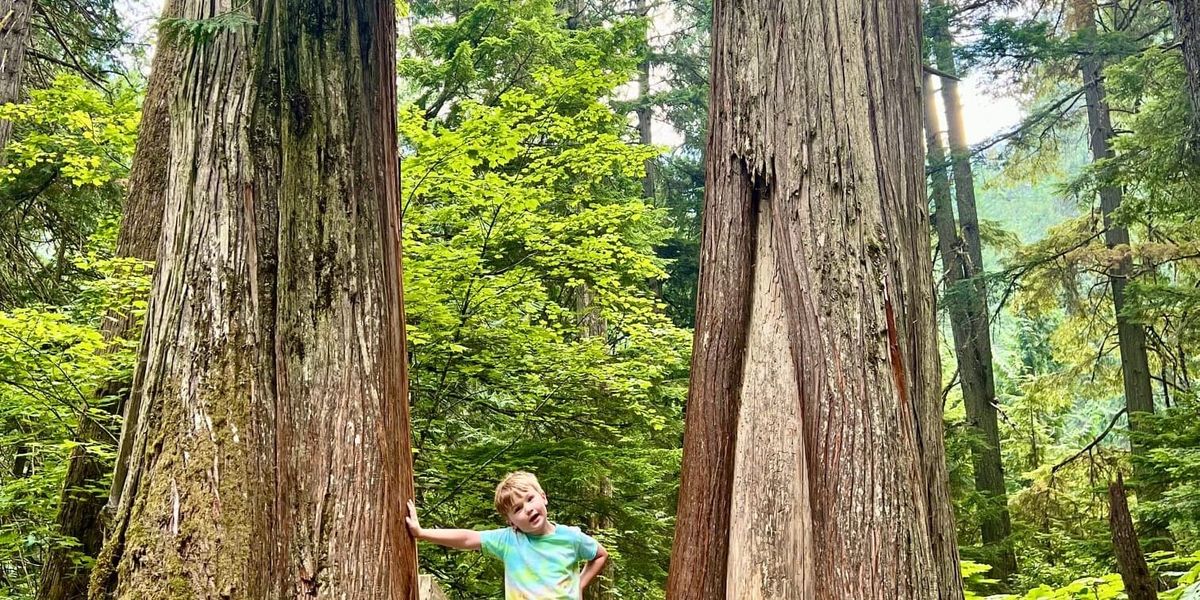
I've spent most summers of my life driving through the mountains of BC and Alberta and this year I did something new: I planned longer stops at natural areas along the way (instead of my usual quick roadside bathroom breaks.) The photo above is from one of those stops outside of Revelstoke. One kid loved it, one refused to get out of the car. Typical.
Comments ()